
The Empty Pavilion: An Architectural Experiment in Speaking with Emptiness
- Jan 14
- 2 min read
The Empty Pavilion offers a calm yet powerful way of looking at Detroit’s evacuated urban fabric. The project questions how architecture can activate forms of public life that still exist in the city but often remain unseen. Its starting point is simple: Detroit has an abundance of one thing—emptiness.
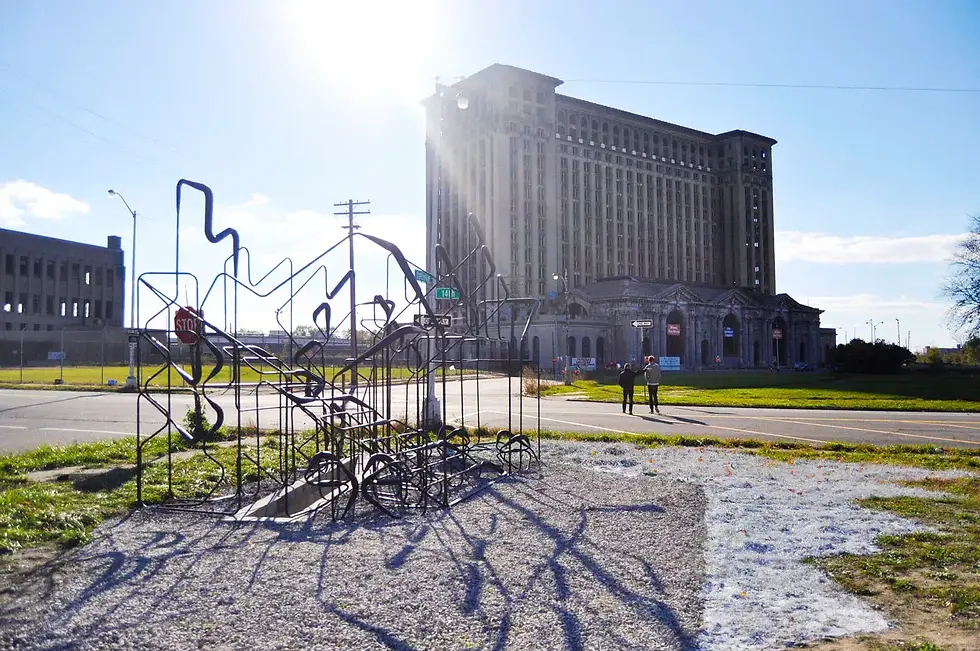
By distributing a minimal amount of material across a vacant site, the pavilion aims to make that emptiness legible. From a distance, the structure invites the onlooker into a subtle visual game. From certain angles, familiar architectural fragments briefly appear—a roofline, a chimney, a narrow hallway, or a staircase. These images never fully resolve, instead leaving space for memory and imagination to complete the scene.
As one moves closer, the experience shifts. Architecture becomes not only something to look at, but something to touch and use. Elements that suggest sitting, lounging, or climbing open the pavilion to bodily engagement. Although constructed from steel tubing, foam, and rubber, the structure feels unexpectedly soft to the touch. This contrast encourages visitors to interact physically and build a more intimate relationship with the pavilion.
The pavilion’s relationship to its site is as important as the structure itself. Located on a vacant lot that was once divided into residential parcels, the project loosely describes the volume of a house that once stood there. The gravel ground plane recalls the shadow of the absent building, while the painted outline of the pavilion marks the shadow of the new structure. Past and present overlap, turning the site into a layered reading of what once was and what now exists.
From within the pavilion, the city is framed anew. A passage carved under and through the structure directs the view toward the empty shell of Detroit’s iconic Michigan Central Railroad Station. Looking in the opposite direction, the Renaissance Center—headquarters of General Motors—comes into view. These framed perspectives position the pavilion not just as an object, but as a tool for seeing the city differently.
Planned to remain in place for one year, The Empty Pavilion is documented through photography and video throughout its life. The goal is not only to record the structure itself, but also to observe the forms of public interaction that emerge around it. The project’s successes, failures, and transformations all become part of the research process.
The Empty Pavilion was realized with support from the Research Through Making grant provided by the University of Michigan Taubman College of Architecture.
Project Info
Project Name: The Empty Pavilion
Year: 2016
Location: Detroit, ABD
Designers: McLain Clutter (University of Michigan Taubman College of Architecture), Kyle Reynolds (University of Wisconsin–Milwaukee School of Architecture and Urban Planning)
Photography: © Sasha Topolnytska


Comments